
Dead Animal Removal Adelaide — Rats, Mice, Possums & Birds
Something's died in your roof. Let's get it out.
There's no mistaking the smell. A dead rat, mouse, possum or bird in a roof void or wall cavity produces an odour that gets into your kitchen, your bedding, your clothes. You can't air it out and you can't cover it. Until the source is found and dealt with, it stays — and in an Adelaide summer it gets worse fast.

I'm based in St Agnes, South Australia, and cover the full Adelaide metro, with same-day response across the northern and north-eastern suburbs.
When you ring, you get me. Not a call centre, not a dispatcher, not a different technician each time. I'll ask you what you're smelling and where, tell you honestly what's likely going on, and give you a straight answer on when I can be there.
📞 +61 457 601 995 — A 30-minute search session on roof void, perimeter, rooftop, gutters — and I'll photograph as I go, so you can see exactly where I've been and what I've checked. You won't have to take my word for it.
I can't promise I'll find it, as they can reach inaccessible areas like a wall cavity. What I can promise is that if I don't find it, an odour bag setup is included.
Dead animals I remove
-
Dead rats and mice — the most common call, usually in a roof void or wall cavity
-
Dead possums — larger, and the smell is significantly worse and lasts longer
-
Dead birds — often in gutters, vents, chimneys, eaves and solar panel cavities, usually associated with bird mites. Birds most often die in chimneys, wall cavities, gutters, downpipes and under solar panels — they get in through small gaps chasing shelter or nesting spots and can't get back out. Solar panel cavities are the one people miss: pigeons nest under panels, and a dead bird up there cooks in summer and drips into the roof space below. If the smell seems to come from high on an outside wall or near the ceiling under your panels, a bird is a fair bet.
Just finished a rat baiting program and now smelling something in the ceiling? That's not unusual — see my rodent control page for how the program works and what to expect afterwards.
Where I find them
-
Roof voids and ceiling cavities
-
Wall cavities
-
Under the house and in subfloor spaces
-
Rooftops, gutters, downpipes and eaves
-
Garages, sheds, decking and yards
-
Behind appliances and in hard-to-reach cavities

Thermal camera inspections: finding what's hidden in roofs and walls
On inspections across Adelaide I use a thermal (infrared) camera. It lets me find what's inside a roof void or wall cavity without cutting anything open. The camera reads surface temperature, so anything warmer or cooler than what's around it shows up on screen. That could be a rodent nest, a bee colony, or a damp patch where fluid has soaked into insulation.
What thermal imaging picks up well:
-
Rodent nests in the roof void. Rats and mice pack their nests with insulation, paper and fabric, and that material holds their body heat. It's invisible to the naked eye and obvious on the camera.
-
Bee colonies inside walls. A honeybee colony keeps its brood at around 34–35°C all year. Inside a brick wall that shows up as a clear warm zone, which tells me where the colony sits before anything gets opened.
-
Damp and fluid-soaked material. Wet insulation and plaster read cooler than the dry material around them. When a carcass has been leaking, that's often the clue that narrows the search.
-
Heat and air leaks at eaves, vents and gaps. Temperature differences around the roofline can point to the gaps animals are using to get in.
A thermal camera doesn't see through walls. It reads the surface. An animal that's been dead for a while cools to the same temperature as everything around it, so the camera alone won't always find it. That's why I use it together with my nose, a snake camera for cavities and a 360° camera for the roof void. Each tool covers what the others miss. I photograph what I find, so you can see it for yourself.
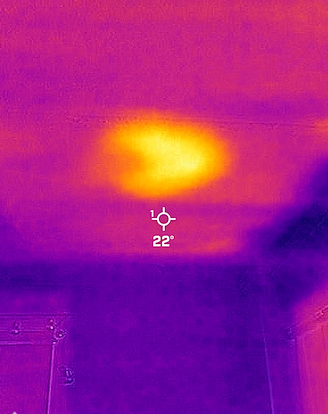
Thermal image of a rodent nest in an Adelaide roof void. The bright patch is body heat held in the nesting material, and it can't be seen with a torch.
Can a thermal camera find a dead animal in the wall?
Sometimes, but not on its own. While decomposition is active, the heat it gives off and the damp patch it leaves can both show up on thermal. Once a carcass has cooled and dried, it's the same temperature as the wall around it. I use thermal to narrow the search, then confirm with a snake camera before anything gets cut.
How a dead animal removal job runs in Adelaide — start to finish
1. We talk first. You tell me what you're smelling, where it's strongest, and when it started. Your input is vital and narrows it down before I even start.
2. I search the likely areas. I work through roof voids, the perimeter, rooftops, gutters and accessible cavities in the order that finds carcasses fastest — strongest odour first, then the places animals actually end up.
3. I remove and bag the carcass. Taken away and disposed of properly. Not left in your bin, if you oppose to it.
4. I clean and disinfect the area. If present, fluids, maggots and contaminated material dealt with, and the surrounding surfaces disinfected. Decomposition fluid soaks into insulation and timber and keeps producing odour long after the body is gone — this step matters more than people expect.
5. Odour treatment. Where odour has spread into the building, or where the carcass sits somewhere I can't reach, I set up an odour bag, so the house is liveable while the rest runs its course. I get mixed reviews on this by clients averaging between 60-90% improvement.
6. I show you how it got in. The carcass is the symptom. I'll walk you through the entry points and what it takes to close them off — whether you book anything further with me or not.

Child and pet safe, start to finish
Every treatment I use is child and pet safe. That's not a line I add to this page — it's how I run every job House Care does.
For dead animal work specifically, that means: no fogging chemicals through your living space, no products left where children or animals can reach them, and clear guidance on when it's fine for the family to be back in the room. If you've got kids, pets, someone pregnant, or anyone with breathing problems in the house, tell me and I'll work around it.
Nothing I use for a dead animal job gets fogged or sprayed through your living space. Where a disinfectant or odour product is needed, I tell you what it is, where it's going, and whether you need to stay out while it dries. Recently I've been asking clients for their preferred products — that's the same standard I'd want in my own family's home.
Is a dead animal in the house actually a health risk?
For most healthy people, the odour itself is unpleasant rather than dangerous. The genuine concerns are the things that follow the carcass:
-
Flies and maggots, which breed in the remains and then spread through the house
-
Ants can also be attracted by the carcass and carry pathogens.
-
Fleas, mites and ticks leaving the body to look for a new host — often your pets
-
Bacteria in decomposition fluid, particularly where it's soaked into insulation or run down a wall cavity
-
A second problem arriving — carcasses attract scavengers and other pests
That's why the clean-up matters as much as the removal. Taking the body away and leaving the rest behind isn't finishing the job.
Dead animal smell in your wall or roof — why it lingers after it's gone
This is the part almost nobody explains, and it's why people get frustrated sometimes, not my clients. Usually it was. Here's what's really happening.
The smell is genuinely still in the building.
Decomposition releases sulphur compounds and other volatiles that soak into porous material — insulation batts, plasterboard, carpet, curtains, timber framing. Removing the carcass stops the smell being produced. It doesn't instantly remove what the house has already absorbed.
It comes back in waves, and that's normal.
Heat drives those absorbed molecules back out of the material; cool air holds them in. Roof voids get very hot on an Adelaide afternoon, so you'll get a clear morning, a bad hour after lunch, then nothing. That pattern makes people think the animal's still there. Usually it's the house releasing what it soaked up. Wind direction also can play a part in those waves.
Your nose stops noticing constant smells — then notices again.
After fifteen or twenty minutes in a room you largely stop registering a steady odour. Walk out to the car, come back in, and it hits you fresh. It's why one person in the house insists it's gone and another swears it isn't. Both are telling the truth about what they're experiencing.
Once you've been primed, you pick it up at far lower levels.
After days of living with it, you're sampling the air without realising. Your detection threshold drops right down, so traces that wouldn't have registered a fortnight ago now stand out. Other smells get misread as the carcass too — a drain, a bin, damp in a cupboard.
And smell hits harder than the other senses.
Odour signals reach the parts of the brain that handle emotion and memory more directly than sight or sound do. That's why this particular problem gets under people's skin the way it does — it disturbs sleep, it puts people off eating, it makes a home feel contaminated rather than just untidy. If you've felt your reaction was out of proportion, it isn't. It's how humans are built.
What I want you to take from that:
Because of all that you can still smell something after I'm gone, and this is not your imagination. It's either residual odour in the materials, which we can work on, or there's a second carcass — and that does happen.

What you can do right now, before I arrive
-
Set up cross-ventilation, not just one open window. Air needs somewhere to come in and somewhere to leave. Open windows on opposite sides so there's a through-draught. If you want put two fans in each opening, one pointing inwards and the other outwards for better air circulation. During winter this is trickier.
-
Move the air out, not around. A fan in a window facing outwards pulls bad air out. A fan pointed into the room just stirs it.
-
Turn off ducted heating and cooling if the smell travels through the vents. Ducted systems distribute odour through a whole house very efficiently.
-
Skip the air freshener. It doesn't neutralise anything. It layers a second smell over the first, and the combination is usually worse.
-
Close off the worst room and ventilate it on its own, so the odour isn't drawn through your living areas.
Don't spray bleach into the wall or roof cavity. Bleach mixed with decomposing organic material can produce genuinely nasty fumes inside an enclosed space — and it doesn't remove the odour source anyway.
Don't cut a hole where the smell is strongest. Odour drifts along cavities and comes out wherever air escapes — the carcass is regularly metres away from the strongest smell point. I've seen plasterboard opened in three places before anyone found the animal. Locating first, cutting second.
Don't rely on incense, candles or strong fragrance. Layering a strong smell over decay doesn't cancel it — it makes a new, worse combination, and your nose stops being able to tell you anything useful about whether the source is still there.
What not to do
What dead animal removal costs in Adelaide
The $150 covers the 30-minute search, removal of an accessible carcass, and one odour bag. What adds cost: hard access (wall cavities that need opening), heavy cleanup (fluids, maggots, soaked insulation), or multiple carcasses — I'll always tell you before doing anything extra.
The carcass is the symptom — carcass removal is only half the job
A dead animal in your roof means a live animal was in your roof a few days ago. The carcass is the symptom — the entry point is the cause. If it isn't found and sealed, the next one is a matter of time. Possums are protected species and they are multiplying fast and their jobs are increasing as time goes by.
If you are looking for long term solutions, prevention is the way to go, and it comes first in everything I do. When I'm up there, I'll show you where they're getting in and what it takes to close it off.
Dead possum removal in Adelaide — what's different
Possums get their own section because they're a different job — legally, practically, and on the nose.
The legal part, in plain terms. All possums in South Australia are protected under the National Parks and Wildlife Act 1972 — it's an offence to catch, harm or kill a living possum without a permit, and brushtails are actually listed as a rare species here. A lot of people find a dead possum and freeze, worried they'll break some law by touching it. To be clear: the protection is about living possums. Dealing with one that has died on your property is not an offence — you're allowed to remove it, and so am I. If what you actually have is a live possum in your roof, that's a different, regulated process (trap-and-release permits, same-property release) — I can point you in the right direction if that's your situation.
Why they die in roofs. Adelaide's older suburbs have lost most of the tree hollows possums naturally den in, so roof cavities became the substitute. A possum that's old, sick, poisoned elsewhere, or injured will often retreat to its den to die — which means it dies in your roof. Summer heat in a roof space also kills them, especially young ones.
Why it's a bigger job than a rat. A brushtail possum is roughly cat-sized — 1.2 to 4.5 kilos of animal. That much body mass means more decomposition fluid, a stronger and longer-lasting odour and heavier contamination of insulation. Removal usually means getting into the roof cavity, extracting it intact, bagging, disinfecting the area, treating the odour, and taking it away — all included in my dead possum removal.
One more thing worth doing. If a possum died in your roof, a possum could get into your roof — and another one will likely find the same entry point. While I'm up there I'll show you where they're getting in. I also proof up entry points so you don't experience this again.
Frequently asked questions in Adelaide
How long does a dead animal smell last?
It depends on the size of the animal, the temperature and how much airflow reaches it. A mouse might clear in a few days. A rat commonly takes two to three weeks. A possum in a roof void can run considerably longer, and residual odour in insulation lingers after the body itself has dried out. Heat speeds decomposition up and makes the smell far stronger while it lasts; cool weather makes it milder but drags it out.
Can I remove a dead animal myself?
You can, if it's out in the open in the yard and you've got gloves and a sealed bag. What I'd avoid is going into a roof void yourself — that's where people fall through ceilings, cut themselves on old wiring, or disturb a nest and end up with a bigger problem. And a carcass in a wall or ceiling cavity generally can't be reached without knowing where to look. If you can't see it, that's the point to ring someone.
How quickly can you come out?
Usually my timeframe to go to a client these days averages 1 to 3 days. I see dead animal removal jobs as an urgent matter, thus I try to be there within a day.
Who do you call for dead animal removal in Adelaide?
On private property — inside your house, your roof, your yard — that's me, Werner, on 0457 601 995. Councils don't come onto private land for this; that responsibility sits with the property owner. On a public road or verge, it's the opposite — that's your council's job, free of charge.
Who removes dead animals — the council or a private service?
Simple split: public land is the council, private property is you.
A dead animal on the road, footpath or verge outside your house — ring your local council, they collect it at no charge. That includes roadkill in front of your place.
Inside your house, in your roof, under the floor, in the yard — that's the property owner's responsibility, and that's where I come in. I service the northern and north-eastern suburbs of Adelaide and cover the full metro area. If you're not sure which side of the line your situation falls on, call me anyway — if it's a council job I'll tell you so and you've lost nothing.
Do you cut into walls or ceilings?
Only if there's no other way to reach the animal, and never without discussing it with you first and getting your say-so. Most carcasses are in reachable places. Where one has died inside a sealed cavity, I'll tell you what's involved and what the alternatives are, including odour treatment, so you can decide.
Is it safe for my kids and pets?
Yes. Everything I use is child and pet safe, and I'll tell you when it's fine for everyone to be back in the room. If there's a pregnancy, asthma or anything else in the house I should know about, tell me and I'll plan the job around it.
Can you always find the animal?
Honestly, no — and I'd rather say that upfront than pretend otherwise. Most are in reachable places and I find them. Some die deep inside a wall cavity where the only access is to cut the wall open, and I won't do that without talking to you first. Where I can't reach it, I set up odour treatment and explain what to expect while it runs its course.
Will an air freshener or a fogger fix the smell?
No. Nothing masks this odour effectively, and most attempts make the house harder to be in rather than easier. Odour treatment genuinely helps make things bearable, but the only real fix is removing the source and cleaning up what it left behind.
Why is the smell worse in the afternoon?
Heat drives odour molecules out of the materials they've soaked into. Roof voids get very hot in an Adelaide afternoon, so the smell peaks then and settles overnight. It's one of the clearest signs that what you're smelling is residue in the building rather than an animal still decomposing.
How do I get rid of dead animal smell in the house?
Two honest answers, depending on whether the carcass is still there.
If it's still in the wall or roof: nothing truly fixes the smell until the body is out. Air fresheners, foggers and sprays only mask it — the source keeps producing odour until it's removed. Cross-ventilation helps you live with it; removal ends it.
If the carcass is already gone and it still smells: that's usually residual odour soaked into porous materials — insulation, timber, plasterboard — or fluids where the animal sat. That's fixable: the affected material gets treated or removed, the surfaces disinfected, and an odour treatment applied. Most clients notice the biggest difference immediately after the carcass is out and the area's treated — typically a 60–90% improvement on the day. The rest fades as treated materials dry and air out. When fluids have soaked deep into insulation or timber, full odour removal can need that material replaced, and I'll tell you if that's your situation.
Do you cover my suburb?
I service the full Adelaide metro area and I'm based in St Agnes, so Adelaide's north-eastern suburbs are my home ground — Tea Tree Gully, Modbury, Golden Grove, Salisbury, Campbelltown, Hope Valley, Surrey Downs, Redwood Park and surrounds.
Get it sorted
Ring me on +61 0457 601 995. Tell me what you're smelling and where, and I'll tell you honestly what's likely going on and what it'll take to fix it.
Werner — House Care Pest Control Local, family-safe, prevention-first